This review originally appeared in Issue 16, published May 16, 2026. You can read this piece and more by purchasing a copy of or subscription to the magazine.
I’m Black and I’m proud! If the completed call and response made famous by James Brown in 1968 is a testament to the success of “Say It Loud: AAMARP 1977 to Now” at the Institute of Contemporary Art / Boston (ICA), then let my declaration be the first order of business. The African American Master Artists-in-Residence Program (AAMARP)—one of the first and longest standing residence programs for Black artists in the United States—has been a key fixture of Black artistic production in Boston for the last five decades. Curated by Jeffrey De Blois and Meghan Clare Considine with direction from the program’s legendary late founder, Dana C. Chandler Jr., the exhibition showcases sixty works of art across seven rooms and includes printmaking, painting, drawing, textile, sculpture, photography, assemblage, and more. Birthed from the Black Arts Movement, these works by AAMARP artists challenge racist American notions and embrace Black culture and self-determination.
A sweet portrait, Dana Smiles (1976) by photographer Reginald L. Jackson, opens the show. Pictured in this photograph is Chandler, young and happy on a sunny day. He is dressed in a blue bucket hat and striped shirt before a blurred green landscape with his eyes closed and a colossal chipped-tooth smile. In this 1976 moment, Chandler was already an accomplished artist, educator, and activist; he was also just getting started. The following year, in partnership with Northeastern University, he founded AAMARP, which would become the cornerstone of his legacy. The vision was to provide Boston’s Black artists with rent-free studios and resources as well as space to exhibit and interact with the broader Boston community. Chandler believed artists are record keepers and knew that with the necessary support in place Black artists would rise to the occasion with testimonies of talent and truth. Since its founding, AAMARP artists have striven to do just that.
Directly across from the portrait of Chandler are three offset prints by the artist and his painting Pan-African Man (c. 1970), which depicts a large-scale brown silhouette of a Black man in profile whose brain is painted in three bold blocks of color—red, black, and green—representing Pan-Africanism. Contrasting sharply with the carefreeness of the show’s opening portrait, this group of works (one of which is signed “by BLACK ARTIST DANA C. CHANDLER JR.”) calls for the freedom of political prisoners, the exploration of the Black psyche, and the rejection of white supremacy. Political critiques and philosophical queries are consistent throughout the show. In the next gallery, Wen-ti Tsen paints the horrors of the Vietnam War contrasted with the seemingly unaffected American way in Peaceable Kingdom (1971), a triptych with two hinged doors. Tsen’s politically pointed style cost him the renewal of his teaching position at the School of the Museum of Fine Arts in 1968, but it would form the foundation of his relationship with AAMARP just a few years later when he met Chandler while working on a temporary guerrilla mural on Boston Common. Nearby is Calvin Burnett’s portrait, Angela Davis (c. late 1970s), of one of the most vocal political activists of our time. Davis’s iconic afro billows outward from her stern and contemplative face. The frame is painted cinnamon red and gold, mirroring the warmth and color of the portrait within.
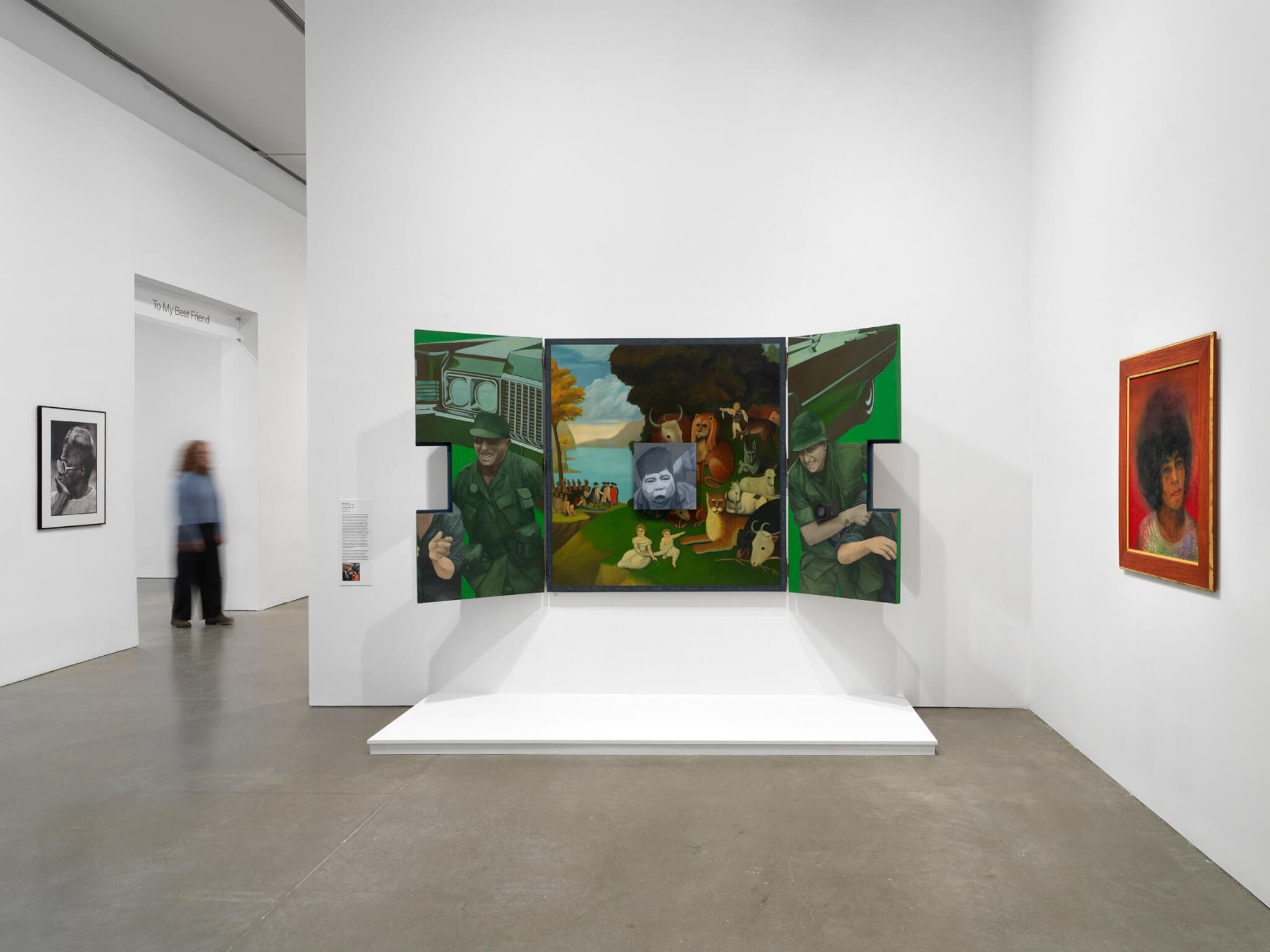
(center) Wen-ti Tsen, Peaceable Kingdom , 1971. (right) Calvin Burnett, Angela Davis, c. late 1970s. Installation view, “Say It Loud: AAMARP, 1977 to Now,” the Institute of Contemporary Art / Boston, 2026. Photo by Dario Lasagni. Courtesy of the ICA / Boston.
Walking through the exhibition, it feels joyous to witness the connections formed between the artists—not just through their official affiliation with AAMARP, but through the works of art themselves and the ways the artists speak to and about one another. The program is not just about a space to work but the sense of belonging as a unique individual within a larger community. Tracing where and how the artists show up within “Say It Loud” evinces this.
A sizable graphite drawing by Allan Rohan Crite titled The Artist and the Community (c. 1984) illustrates African royalty surrounding artists and other members of his local community centered at the bottom. Among the artists depicted are recognizable members of the Boston Collective, the group of younger artists that Crite mentored, including Napoleon Jones-Henderson, Johnetta Tinker, Susan Thompson, and others. Elsewhere, Thompson appears again in James Reuben Reed’s The Mask Maker (Portrait of Susan Thompson) (1983). This vivid painting of Thompson depicts the artist at work cutting metal for a mask that rests on a table beside her. Cascading around her face like the nemes worn by pharaohs is a colorful scarf of blue, red, black, white, and yellow stripes. Around the corner, photographs of Thompson punctuate a wall of archival images. In yet another gallery, two indigo-dyed quilts made by Thompson herself, Call of the Ancestors 1and 2 (2007), hang side by side.
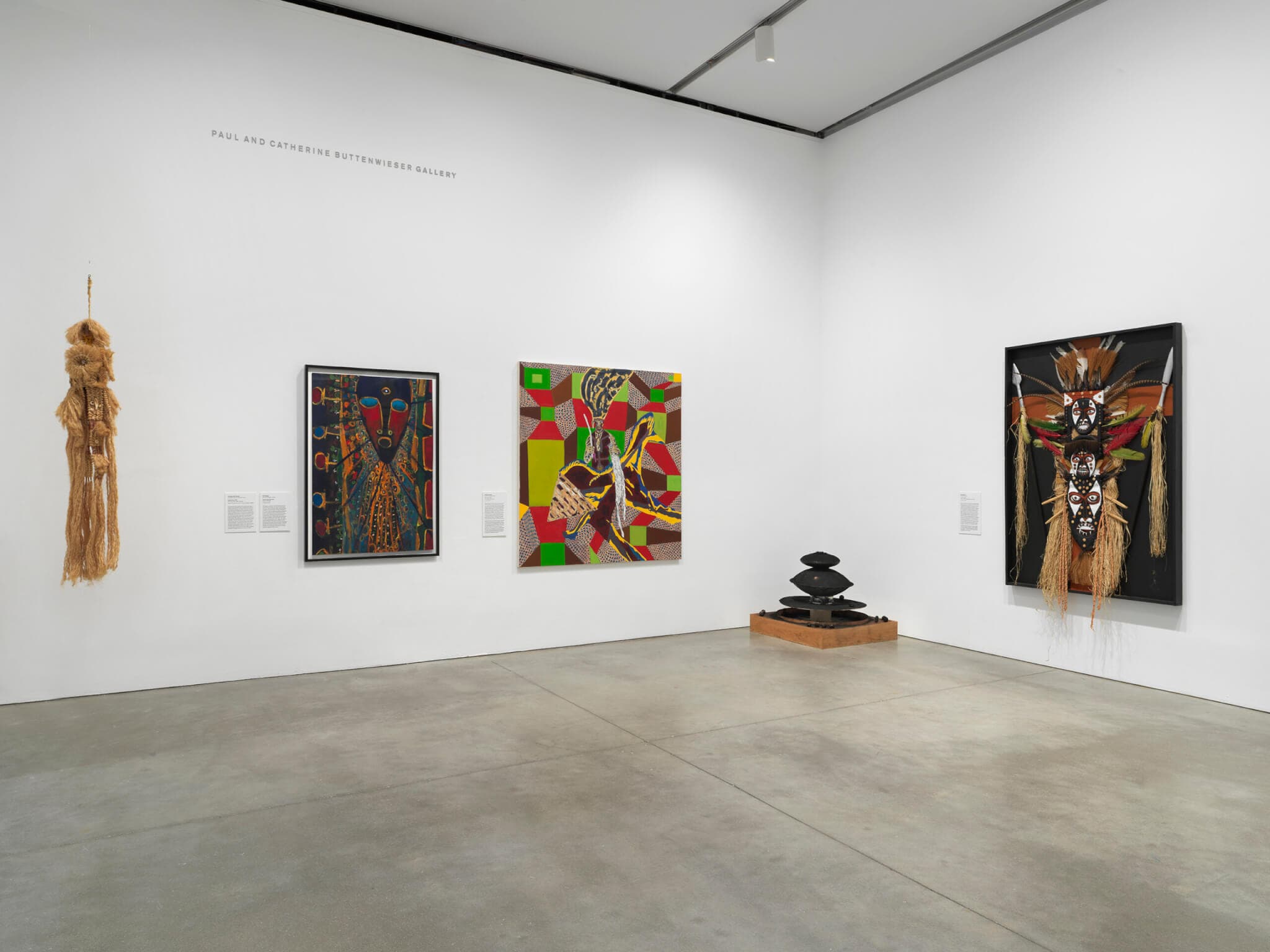
Before I knew what a visual lexicon was, Vusumuzi Maduna had sown seeds within mine through his public installations inside my elementary school, the Martin Luther King Jr. School, and outside the Cambridge Community Center, where I spent time after school and during summers. Hanging high at the ICA, Maduna’s JuJu Blue (1978–79) colors a mask with a base layer of black paint with yellow and blue accents on each side. Almond-shaped white eyes framed by thick wooden eyebrows are striking above a reddish tongue that sticks out, revealing a mouth full of nails. The mask is topped with dark metal mesh built upward like a headdress. Maduna is known to draw on African culture: The style of this sculptural mask takes inspiration from the Dogon, while its titular “juju” may refer to the popular Yoruba musical genre and/or West African spiritual and energetic beliefs. The adjacent gallery presents another Africanism embraced by Maduna in Ibeji (The Twins) (1981). After the passing of one sibling, the practice of creating and honoring these dual sculptures sustains the material presence of a loved one. In Maduna’s sculpture, the twins represent himself and his twin sister, tightly framed. With rope for hair, smooth, bold cuts of wood define their figures: one arm wraps around his sister while the other holds a spear. All but their faces are black and dark brown, and above their brightly colored eyes and lips, each twin has a mirrored third eye.
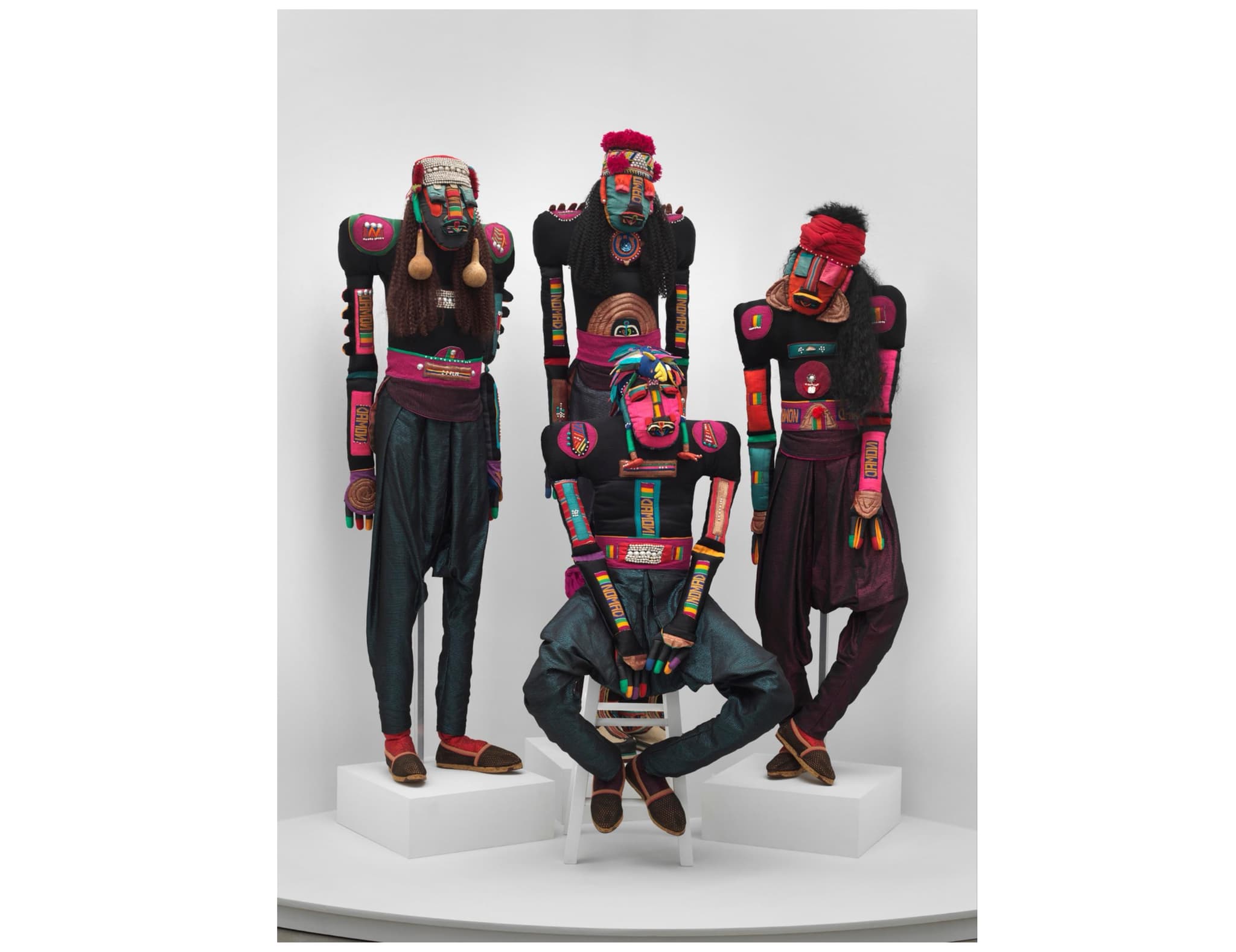
Barbara Ward, New Race II, 1987–88. Installation view, “Say It Loud: AAMARP, 1977 to Now,” the Institute of Contemporary Art / Boston, 2026. Photo by Dario Lasagni. Courtesy of Cambridge Public Library Archives and Special Collections.
Barbara Ward’s set of four soft sculptures that are human-like in stature and posture and titled New Race II (1987–88) occupy a substantial corner of the show. Fabrics of different textures make up their base colors of deep purple, teal, and black while bright fuchsia and yellow topped with shiny beaded accents pop. A central seated figure that bears an equally colorful chicken on its head is surrounded by three standing figures with long curly locs. “Nomad” is sewn onto the upper body of each figure repeatedly; sometimes the text is inverted, as though this new race may bring new meaning to the word. The quartet has a presence such that I felt as though I were approaching a group of beings rather than observing works of art. Shifting back toward the familiar, close by Paul Goodnight’s A room full of sisters (1997–98) brings a layered composition of mixed materials that fills the canvas with a scene of women at varying depths and scales. Grounded by an African mask in the bottom center, each figure interacts with a unifying turquoise and gold cloth that runs in a horizontal wave across the piece. The work typifies the diversity and commonality among Black women.
A room invites visitors to reflect on AAMARP’s enduring impact on Boston’s art community. Here, an entire wall is collaged with reproductions of AAMARP artifacts, such as photographs and promotional materials. The photographs show AAMARP artists and their visitors at the studios and events, and several flyers recall exhibitions past. The display evinces the deep-rooted community engagement and prolific artistic production of the program. On an adjacent wall, archival footage from Boston PBS affiliate GBH allows visitors to hear directly from several of the AAMARP artists during the earlier years of the program. This section primarily features Say Brother, a television series dedicated to addressing the concerns and interests of Black people in Boston that debuted in 1968. It also includes snippets from La Plaza, Ten O’Clock News, and Greater Boston Arts. Running about thirty-five minutes, the full footage loop is fairly lengthy for an art exhibition but well worth watching. Visitors may hear soundbites from it throughout the galleries, and it bears noting that extended recordings are available through the GBH archives online.
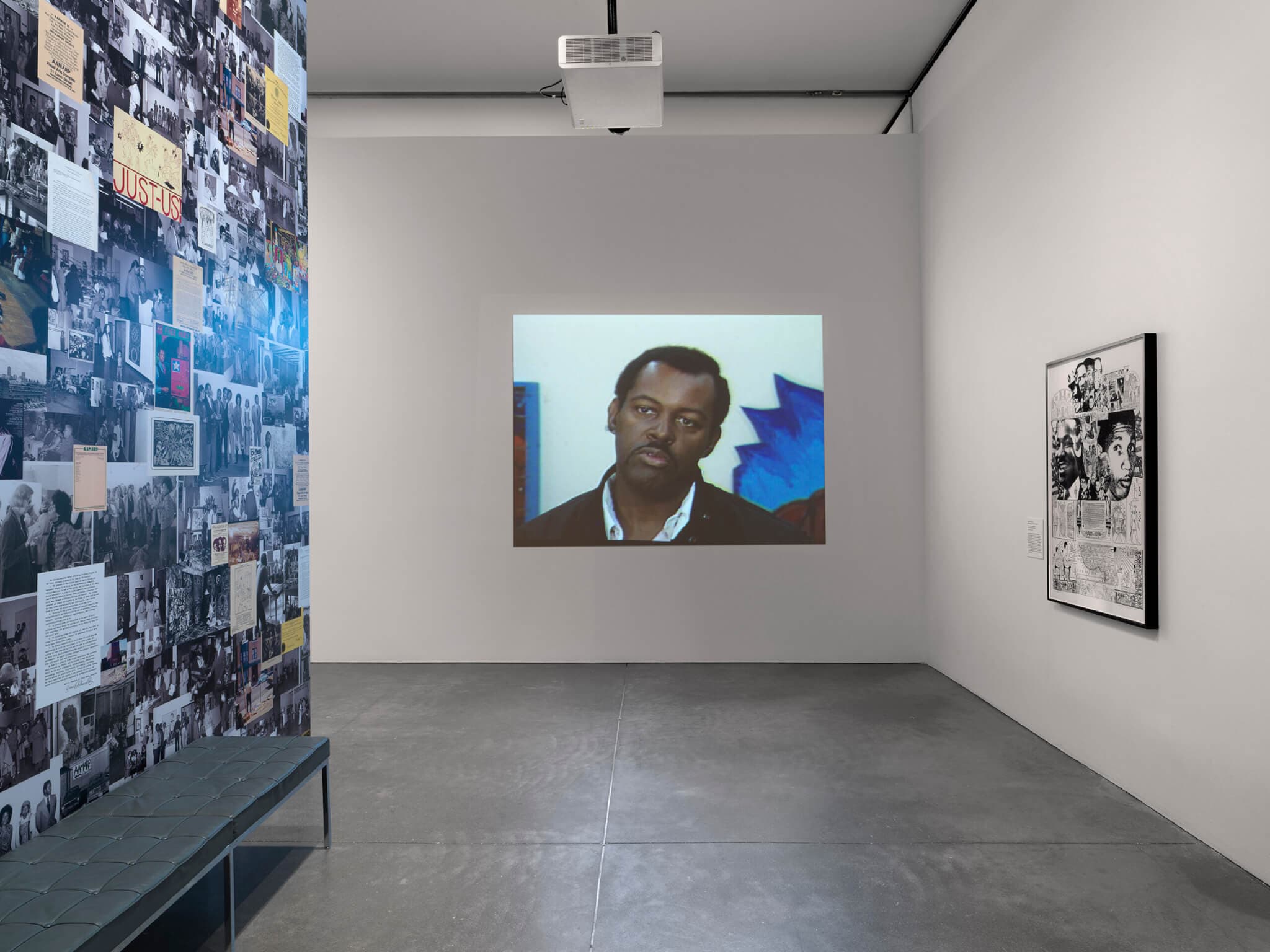
(center) WGBH Archival video, 1969–2000. Courtesy WGBH Media Library and Archives. (right) Dana C. Chandler Jr., For the Children We Strive, 1991. Courtesy Jeff Chandler. Installation view, “Say It Loud: AAMARP, 1977 to Now,” the Institute of Contemporary Art / Boston, 2026. Photo by Dario Lasagni. Courtesy of the ICA / Boston.
The videos and photographs that blanket this particular room at the ICA echo Chandler’s Urban Newsletter Art Piece (1993; also on view). In this piece, Chandler famously responded to Northeastern provost Michael Baer’s 75-percent cut of AAMARP’s budget and removal of Chandler as the program director in 1993 on the grounds that the program was not successfully aligned with the university’s broader aims and was in need of “rejuvenation.” Across twenty-five pages, the artist details the intense creative production and significance of the program. The piece also accuses Northeastern of using AAMARP as leverage to acquire the building at 76 Atherton Street amid community concerns about gentrification. Despite Chandler’s protests, Northeastern pushed forward with these changes, significantly damaging the relationship between the program and university. Until recently, Northeastern had limited artists’ access to their studios to weekday hours, and in 2018, Northeastern’s Facilities Department ordered the program to vacate, citing code violations. Decades of conflict over space, governance, and autonomy have kept the program in a precarious position, even as its cultural significance to Boston remains widely recognized. In this room of the exhibition, so purposefully built for reflection, I cannot help but think about the future of AAMARP. Northeastern’s support for the program continues to dwindle, and the battle to sustain the program is ongoing.
I’m Black and I’m proud. What’s more, I’m Black and proud to be from here, where Black artists are consistent and persistent. The presence of our Black population is routinely overlooked and undermined in conversations about this historic American city, but we have never let up. I’m confident that we never will. “Say It Loud” at the ICA is at once a call for celebration and a demand for a reckoning of the profound contributions of Black artists in Boston.
“Say It Loud: AAMARP, 1977 to Now” is on view through August 2, 2026, at the ICA / Boston, 25 Harbor Shore Drive, Boston, MA.