Published January 31, 2026 at 9:15 AM
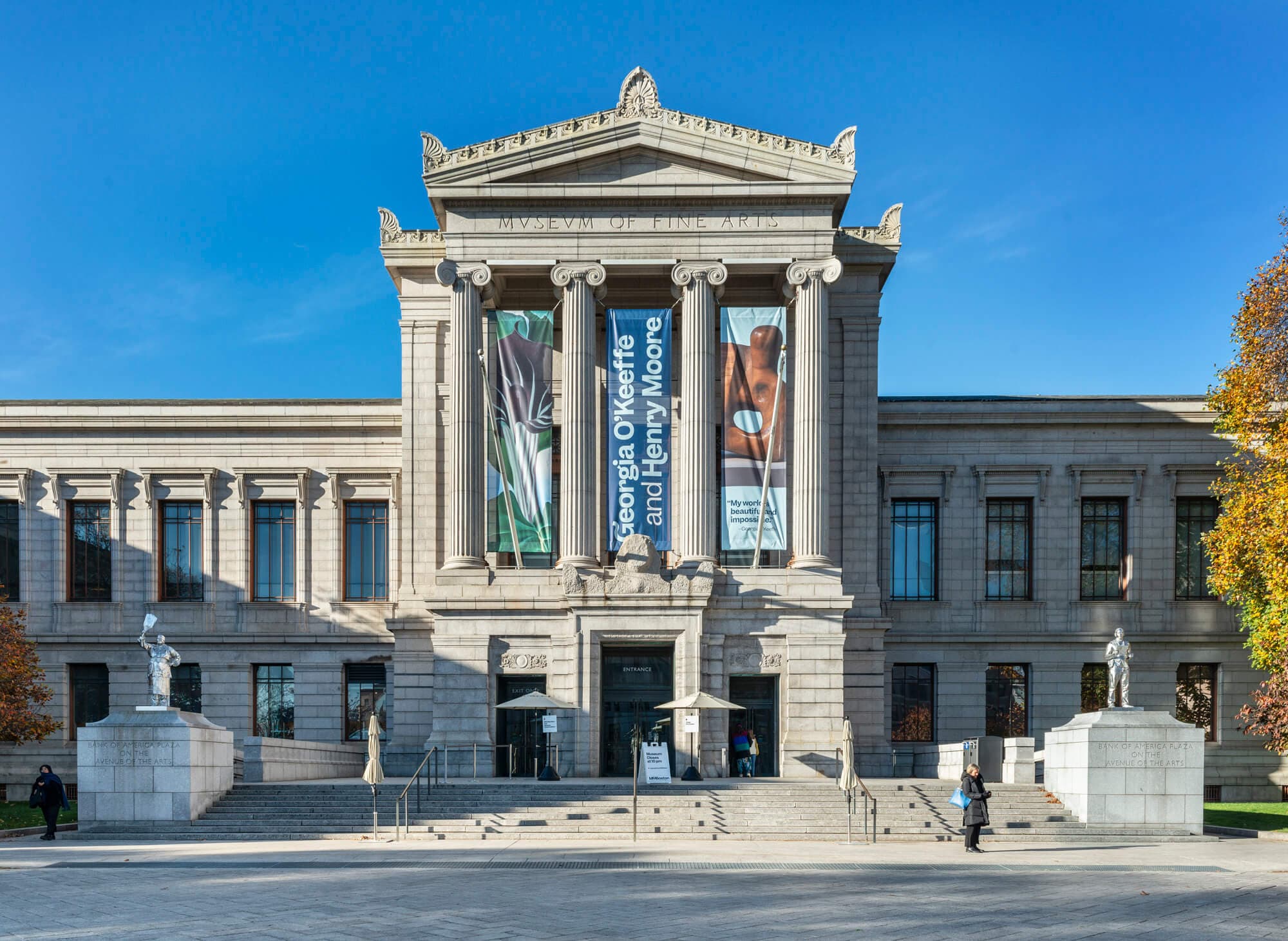
Roughly twenty-four hours after employees began to be notified of the Museum of Fine Arts (MFA) Boston’s decision to lay off staff, a picture began to emerge of how new resource allocation articulates possible shifting values at the institution and a lack of good faith between museum leadership, the MFA Union, and the Boston community at large.
The lack of transparency around which positions were identified for elimination and the abrupt communication of the headcount reduction as a solution to the museum’s budget deficit appears to signal two difficult messages: a de-prioritization of diversity, equity, and inclusion (DEI) initiatives at the museum and how US labor law has defanged the power of collective bargaining. Against the backdrop of the Trump administration’s targeting of DEI policy at universities and cultural institutions and expanding ICE raids, the layoffs are causing a community-wide crisis of confidence that good faith is guiding leadership at one of Boston’s leading art institutions.
The crisis began the morning of Wednesday, January 27, when the Boston Globe published a story that the MFA Boston would be laying off “6.3% of total active employees,” per the museum’s statement. That afternoon, the MFA Union—the local chapter of the 2110 Auto Workers Union which, per union representative Eve Mayberger, represents approximately 330 of roughly 520 of museum staff and is one of three unions representing staff at the museum—posted on Instagram that they had been alerted “late in the day yesterday” about the layoffs.
Notably, the Boston Globe article reporting on the impending layoffs cited numbers not listed in the first communication from museum leadership, an email that MFA staff received on January 26 from the head of human resources, Jane O’Reilly. The email time stamped 2:48 pm alerted staff to be available to their department head and that the last day of work for those whose roles were to be eliminated would be Friday, January 30. “There was an email sent at three o’clock on Tuesday announcing that this was coming and that announcements would have been made on Wednesday. The union received a call about five minutes beforehand to our local 2110 representative giving her notice that this was happening,” said Mayberger on a call on Friday afternoon. “We immediately then filed a fairly extensive request for information petition that evening. But we didn’t receive any further information until later.”
In Nov 2020 in a landslide election—133 to 14 across thirty departments—staff at the MFA voted to unionize. The first contract took eighteen months to negotiate and went into effect in 2022. The decision to unionize means that museum leadership is under direction to bargain with union leadership in good faith. Direction, however, is not a legal obligation. Under the Worker Adjustment and Retraining Notification (WARN) Act, organizations with more than one hundred employees are required to provide sixty days notice if the layoffs will include more than 33 percent of staff. A 6.3-percent staff reduction in this round of layoffs does not meet the threshold to trigger the WARN Act.
Eliminated positions include sixteen union members, seventeen non-union members, and twenty-three vacant positions. The museum, which has an endowment of $830 million, cited a $13 million operating loss as the reason for the cuts and said that staff reductions will partially close that gap by $5.4 million. The strategy for how to meet the remaining $7.6 million budget shortfall has not been addressed.
The museum has characterized the layoffs as a “last resort.” In an email the museum’s press representative Karen Frascona explained, “The decision to implement a reduction in force only became clear the end of December during our FY27 budget process and broader analysis and discussion regarding the Museum’s financial future. As such, it would have been premature to include a discussion regarding layoffs during the parties’ contract negotiations.”
Further, the parties’ CBA [Collective Bargaining Agreement] expressly reserves to the Museum the right to layoff employees. This reservation of rights constitutes a clear and unmistakable waiver of the Union’s right to bargain over the Museum’s decision to layoff members of the bargaining unit. Moreover, the Museum is not obligated to provide advance notice to the Union where it remits two weeks’ pay in lieu of notice, which the Museum did so for all affected Employees.”
“The union’s position right now is we are just trying to be there for our affected colleagues. We are disappointed that the museum chose this option first, and we are going to be reviewing all avenues available to us to see how we can better support those affected, both directly and then also the people that are here,” said Mayberger.
The last time the museum faced layoffs, during the Covid-19 pandemic, the then-director of the museum, Matthew Teitelbaum, shared belt-tightening and took a 30-percent pay reduction. The MFA’s 2024 financial statements indicate Teitelbaum’s salary in 2024 was $1,037,098. The museum’s 2025 compensation numbers have yet to be reported, but no similar pay cut for Pierre Terjanian, who stepped into the role of Director and CEO July 1, 2025, has been announced. Additionally, early retirement was offered as an option during the 2020 pandemic-related layoffs. No similar offer has been made this round.
The museum press office confirmed via email that no members of museum leadership have taken a pay cut, but that the position of COO has been eliminated. Last held by Eric Woods, the COO position was one of the twenty-three vacant positions removed in the restructuring process.
Details around which positions have been eliminated are still emerging. The curatorial staff lost seven positions. Early confirmations so far include theo tyson, Curator of Fashion Arts; Dr. Marina Tyquiengco (CHamoru), Ellyn McColgan Associate Curator of Native American Art; and Dr. Nadirah Mansour, Assistant Curator of Islamic Art. All identify as BIPOC curators of color.
Additional reported curatorial layoffs include: Nancy Berliner, Wu Tung Senior Curator of Chinese Art; Patrick Murphy, Lia and William Poorvu Assistant Curator of Prints and Drawings; Anne Havinga, Estrellita and Yousuf Karsh Senior Curator of Photographs, and Marietta Cambareri, Senior Curator of European Sculpture, and Jetskalina H. Phillips Curator of Judaica.
From education, community engagement, and equity and inclusion departments reported eliminated positions include: Darcy-Tell Morales, Patti and Jonathan Kraft Chief of Learning and Community Engagement; Monica Irina Garcia, Senior Manager of Equity Programs and Audience Development; Tracy Brown, Senior Director of Belonging and Inclusion; Ronald Carroll, Director of Teen Programs; and Ruby Rosenwasser, Teen Arts Council & Curatorial Study Hall Coordinator; along with other members of the education department whose roles were focused on youth and teens.
From the archival department, reported staff reductions include: Maureen Melton, Susan Morse Hilles Director of Archives and Museum Historian, and Paul McAlpine, who worked in the MFA’s library in archive and collections management. Confirmation of the full extent of eliminated positions is still ongoing.
Notably, several of these and other, still unconfirmed eliminated roles are endowed positions causing additional confusion around the legality of their elimination. Since each named position is endowed by different donors’ gifts, each is uniquely governed pursuant to their individual contracts, meaning each will require individual review. The Lilly Endowment declined to comment on the elimination of their named Assistant Curator of Islamic Arts role.
“This reduction in force was implemented to not only reduce expenses, but also as part of a larger restructuring plan designed to safeguard the Museum’s ability to meet its mission under the financial hardship it currently faces. This necessitated a review of all staff positions, even funded positions, in relation to the Museum’s mission,” explained the museum press office via email.
The MFA’s mission statement declares that “the Museum has obligations to the people of Boston and New England, across the nation and abroad. It celebrates diverse cultures and welcomes new and broader constituencies. The Museum is a place in which to see and to learn. It stimulates in its visitors a sense of pleasure, pride and discovery which provides aesthetic challenge and leads to a greater cultural awareness and discernment.”
The reduction of staff overseeing Chinese art, the only positions solely focused on Islamic art and Native American collections, and staff tasked with overseeing diversity efforts appears to undermine this aspect of the museum’s mission. Though the curatorial department suffered significant staff losses, the museum’s press office emphasized that there are “no plans to deaccession any works.”
Community reaction to these cuts has been swift. A change.org petition to reinstate Mansour, Tyquiengco, and tyson (who the petition identifies as the only Black curator at the MFA), as well as other BIPOC staff members including Carroll and Rosenwasser, has already been posted and is circulating. The faculty of MassArt are likewise planning to publish an open letter to the MFA Boston requesting the museum to reconsider these layoffs. Boston Art Review has reviewed an advance copy of the letter, which has already gathered nearly 100 signatories ahead of its release.
On social media, public comments on @MFABoston posts indicate community frustration with the priorities that these changes signal. Comments like, “Cutting Islamic and Native American art curators while claiming inclusivity is a clear statement of whose histories and communities the MFA actually values. These layoffs speak volume. Representation is not just a slogan” are accumulating.
The union voted to ratify a second labor contract with the museum in August 2025. For now, the lack of transparency surrounding why specific departments were identified for closure is further eroding trust in museum leadership. “I would say the decision making process was pretty guarded very high up. It’s been interesting to me seeing just how high up the surprise has gone when this announcement came.” said Mayberger.
This is a developing story and will continue to be updated.
For tips, please email kim@bostonartreview.com
Jessica Shearer, senior editor at Boston Art Review, also contributed reporting to this piece.